

Wiener Schnitzel: The Story Behind Vienna's Most Famous Dish
The Wiener Schnitzel is the most ordered dish in Austria, officially listed in the register of traditional foods and for many visitors the very first stop on their culinary journey through Vienna. Yet behind the golden-brown classic, there is far more than just a crispy coating.

The Wiener Schnitzel has a long history stretching back to the 18th century. As early as 1798, Viennese cookbooks contain recipes for breaded veal cutlets. The name "Wiener Schnitzel" has been in use since 1831, when cookbook author Maria Anna Neudecker first put it to paper. Breading meat had long been common practice in Viennese cooking – the Backhendl goes back as far as 1719. The Schnitzel is therefore not a foreign invention, but a home-grown development of a well-established culinary tradition.
In the beginning it was a festive dish, appearing on the table only at Christmas, New Year or weddings. Veal was expensive and the preparation demanding. It was not until the 19th century, as Wirtshaus culture flourished and the middle class grew, that the Schnitzel found its way into everyday Wirtshaus life. And that was the moment it became immortal.
What a genuine Wiener Schnitzel is
A genuine Wiener Schnitzel is made from veal. That is not a matter of taste – it is a matter of definition. Anyone using pork must label it in Austria as "Schnitzel nach Wiener Art" – Wiener-style. The distinction is regulated by law and taken very seriously by those in the know.
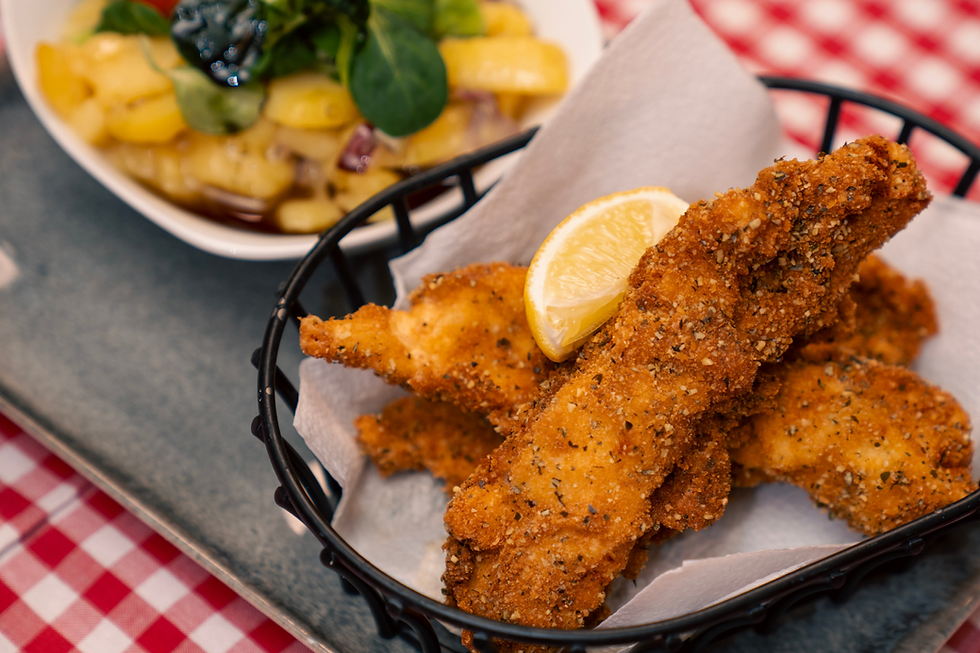
The coating consists of three layers: flour, beaten egg and freshly grated breadcrumbs. The crucial detail is that the breadcrumbs must not be pressed in. Only then can the coating "soufflieren" during frying – lifting slightly away from the meat to form a loose, golden shell. This is the hallmark of a genuine Wiener Schnitzel and the difference between good and very good.

A cultural icon with worldwide fame
By the 1860s, the Wiener Schnitzel was already so internationally renowned that it was served to Napoleon III and his wife Eugénie as "Côtelettes de veau à la viennoise". Today it is often the first dish tourists from around the world want to order when they arrive in Vienna – and rightly so. It is one of the rare dishes that actually tastes as good as you imagined it would.
For many Viennese, the Schnitzel is childhood memory, Sunday staple and soul food all at once. It stands for reliability. You know what you're getting – and that is precisely the point.
Variations worth knowing
The classic Wiener Schnitzel is served with potato salad or parsley potatoes and a wedge of lemon. Anyone ordering a pork version is eating a Schnitzel nach Wiener Art, which is widely served in many Wirtshäuser and has its own charm.
Beyond that there is the Naturschnitzel – without any coating – the Rahmschnitzel with a sour cream sauce, and the Jägerschnitzel with a mushroom sauce. All perfectly legitimate variations, but a long way from the original. Anyone visiting Vienna who wants the real experience orders the Wiener Schnitzel from veal and takes their time with it.



Comments